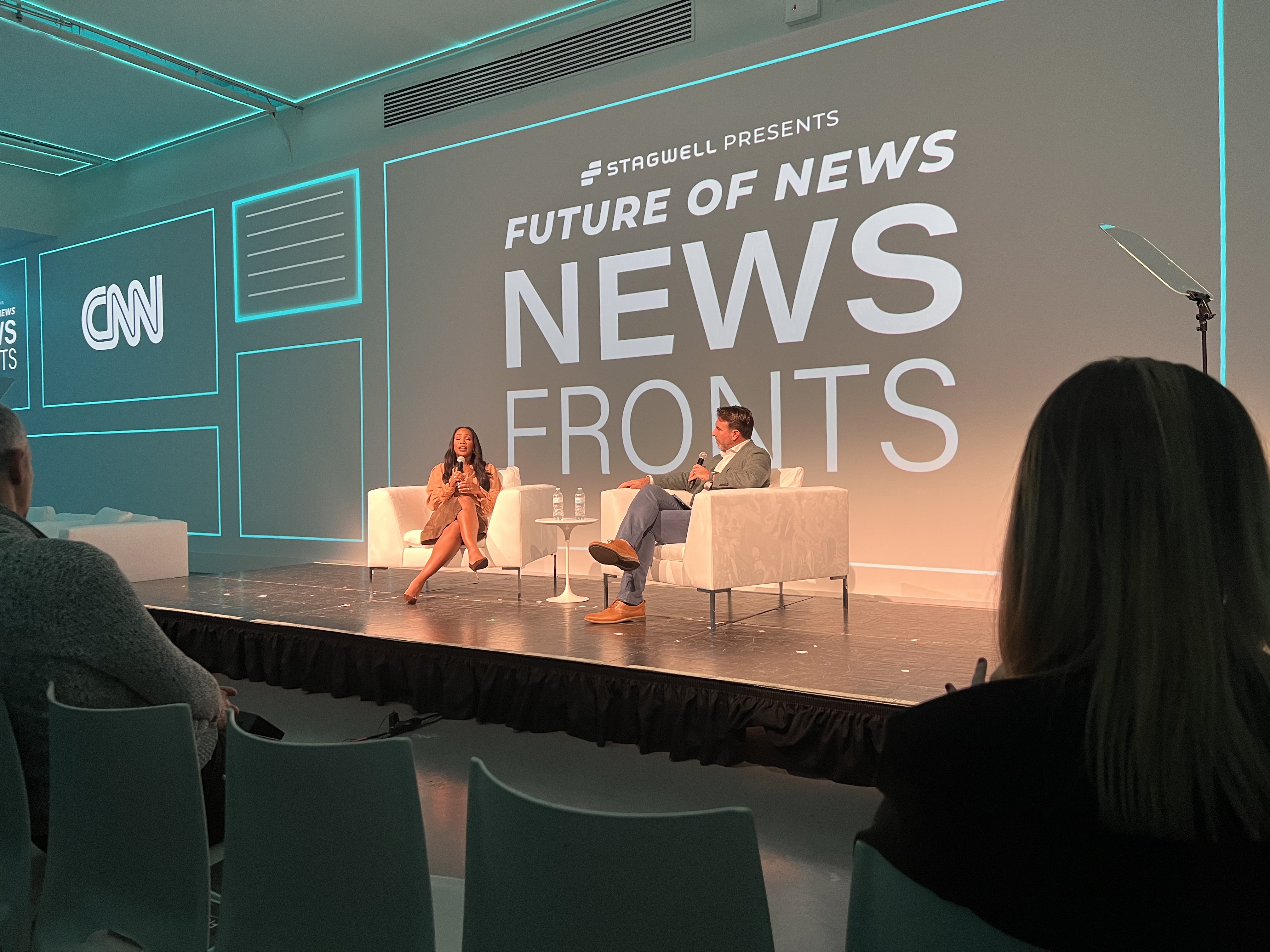
I spent much of yesterday on Manhattan’s West Side, where a hundred or so media types gathered to discuss The Future of News. It was a glitzy event staged by Stagwell, one of the more forward-thinking marketing outfits, and happened at a place called Lavan Midtown. It was an appropriate setting— so futuristic, with its white walls in permanent motion, swimming with happy colours alongside the brand names of participants: NBC, The Financial Times, Axel Springer, Gannett, Axios . . .
I have some thoughts about the event, and then a confession
The sessions were headlined with the usual upbeat, somehow meaningless, titles:
REBOOTING THE NEWS PRODUCT FOR THE NEXT GENERATION
TURNING ATTENTION INTO IMPACT
Eager speakers hopped around the stage, ticking off their farseeing ideas and innovations, all of them delivered with a blizzard of jargon and hardly a blink of doubt. We heard about the magic of new technology and the still unmeasured wonders and possible dangers of AI. It was impossible to know which of these dazzling blueprints for the future might work best.
The striking thing for me, amid the non-stop waves of bright-eyed optimism, was a word that echoed through the whole day.
TRUST
Speaker after speaker repeated this word, though mainly to emphasize the “trust” they claimed for their particular brands.
No one mentioned that the news media is suffering a famine of trust; that a Gallup poll was released only two weeks ago showing that trust in mass news media is plunging; that in the 1970s it was at 70 percent of the population and had now plunged to a mere 28 percent.
That’s easy to understand, put in the context of a world flooded daily through social media with a crazy avalanche of lies and conspiracy theories; when a huge percentage of young people rely on unmonitored posts for their “news”; when powerful people pour scorn on the traditional media. It’s a truism that lies repeated again and again can turn into truth in the heads of many.
The man from Axel Springer said it best yesterday: “Misinformation spreads faster than the truth.”
That’s not a new thought . . . Jonathan Swift said the same thing more poetically: “Falsehood flies, and truth comes limping after it, so that when men come to be undeceived, it is too late.”
Swift wrote those words more than three hundred years ago, when print was a wonder of the world, so it’s not a new problem. But he could never have imagined today’s unending torrent of deceit.
Healthy societies are held together by a chain of trust and forbearance, the readiness to tolerate their differences. This chain can be threatened by mad and malign liars, especially when those liars include people in positions of great power.
I have spent decades in the news industry and left that meeting with feelings of hope and apprehension. Hope that their rosy plans bear fruit for them all, that they can rebuild the trust in their truth; and apprehension at the formidable hurdles awaiting them.
Finally, my confession. I have spent decades in the news business and cannot count the number of events such as this that I have been required to sit through. I remember in the mid-1990s, when one presenter spoke with such shining confidence about the durable future of printed newspapers that the audience cheered him.
That speaker was me, so I know what it’s like to get it wrong.
*I’m about to publish a novel, Dying Days, that imagines the catastrophic consequences of growing antagonism towards news media. It’s far-fetched fiction, I hope, although the author Jeffrey Archer read it and wrote “it’s an original story told with frightening conviction . . . Could it happen?” ORDER ON AMAZON NOW


When I was a kid, Walter Cronkite read the evening news on CBS and he was dubbed the most trusted man in America. Now either journalists or lawyers rate as the least respected. It’s gotten worse over the last years where more people get their news from facebook than papers or TV. I used to talk to students when I was at People and all I could tell them was to be sure to get it right in an era where it was and still seems to be more important to get it first. We were lucky to work in the Golden Era which I believe to be over and not coming back. Regards Les. Ira Berger
As an Engineer who spent over 25 yrs working for news and watching the presses change from sadles to plates and then the drives changed from gear to digital drives ,watching man power deplete guess its progress,my grand father was a cartier here in Liverpool and when the Ford wagons turned up he had to adapt so nothing is new.