Archive | Uncategorized RSS feed for this section

THE MANY SHADES OF MURDOCH

26 Jun

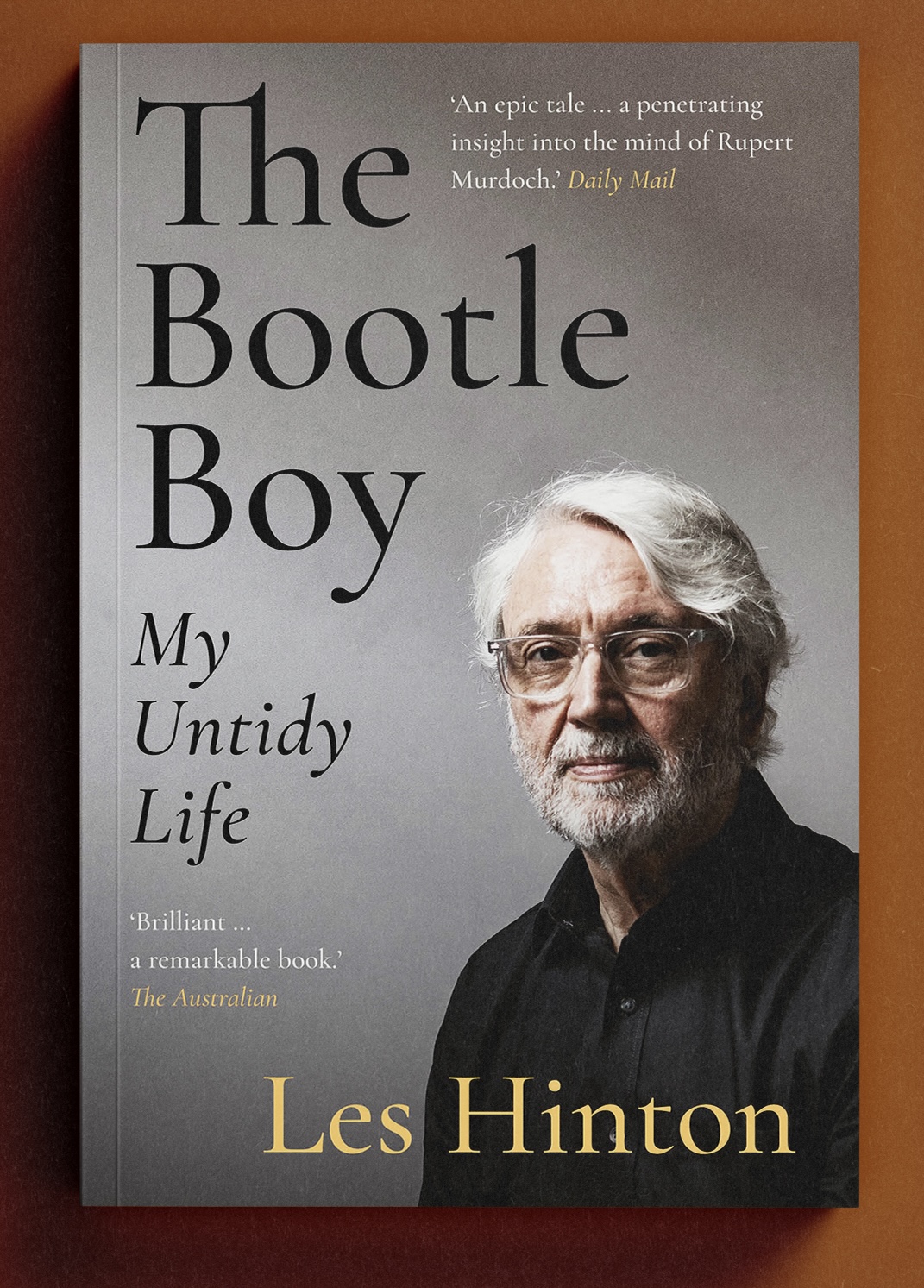
I wrote a memoir called The Bootle Boy. It tells the story of my life, and Rupert Murdoch is one of its central characters.

Murdoch has attracted admirers and fierce critics in equal measure. I worked with him for fifty years, so I had to find a way to tell my story honestly—without being accused either of biting the hand that fed me or of seeming like a brainwashed Murdoch cultist.

The result is my own account: personal, candid and, I hope, fair. Whether you admire Rupert Murdoch, dislike him, or simply want to understand the man behind the headlines, you may find something that surprises you.

As I write in my book:“He could be hands-off or autocratic, charming or irascible, forgiving or fierce, and sometimes just a comprehensive pain.

Below are excerpts from The Bootle Boy. And you can buy a copy here https://mybook.to/TheBootleBoy

Now and then, he would seem vulnerable. We were about to close the $3 billion acquisition of the Triangle publishing group, which included TV Guide, with a weekly circulation of almost 17 million. It was the biggest publishing deal in US history and a high-stress moment.

We were waiting in a motel near Triangle’s HQ in Radnor, Pennsylvania. Lawyers and finance people were working the phones in an ill-lit conference room, organising the wiring of cash to the seller’s banks. Rupert was standing in the lobby with me and a couple of others, talking about what we would do when we walked into Triangle’s huge offices to take over the business. Here was the tough and invincible mogul on the brink of another mega deal. But then I saw a red smear on his fingers, staining the white handkerchief he had taken from the breast pocket of his jacket. He had picked at the cuticles of his fingernails until they were bleeding.

He could be in pain when things went wrong. During a company crisis, he had to sell a stable of magazines.

He organised a dinner for the departing executives, about 50 of them, and we sat in his office early that evening discussing what he would say to them. He wanted to be sure to have a grateful remark for every individual in the room. He put down his pen at last and looked silently across his office, in the direction of a wall of television screens.

‘I feel like I’ve let them all down,’ he said.

But he could also be tough and terrifying towards the people working for him.


I became good at providing therapy to executives and editors who suddenly felt out in the cold. Sophisticated people would come to me, wounded because ‘Rupert hasn’t called me for more than a month.’
My response was always the same: ‘Lucky you.’
He was like a visiting comet and the mysterious astronomy of Rupert made it impossible to know when he would appear and how long he would stay.
In meetings, he went easy on junior people; he must have seen how terrified some were. But, with senior people who displeased him, he could be savage. I consoled over drinks more than one tearful editor. He would often ask, when one more beaten executive walked limply from his office: ’Did go too far?’ Usually the answer was yes.”

Copyright © Les Hinton 2026

MEMORIES OF BOOTLE

8 Jun

“If ever I had roots, they were here, and if a life’s foundation begins with the ground from which it emerges, then tough and blighted Bootle, and the people there who loved me, must go some way to understanding mine”  – THE BOOTLE BOY, updated 2026 edition.

“A life builds on itself, but its architecture follows no rules. It can appear at the beginning to have a strong foundation and then be swept away in the first storm, mystifying those who failed to see the flaws in its design. It can seem ramshackle, yet rebuild itself to withstand whirlwinds. My own life has surprised itself again and again. In my first15 years, we moved so many times I didn’t understand what people meant when they talked about the comfort of being ‘home’. I still don’t get it, but eventually, when I was older, I worked out my own personal definition. We lived in Egypt, Eritrea, Libya, Singapore, and the British occupied zone in West Germany – all places where, for one imperial reason or another, the British had some kind of control. They were the dying days of the Empire, and everywhere we went the sun was setting on it.

Between these postings – most of them lasting a couple of years – we existed in a limbo the army called ‘transit’, which meant spending weeks or months any place the military could make a deal to accommodate us. We stayed at seaside boarding-houses in the seedy charm of Blackpool by the promenade and near the pier in Southend-on-Sea. We lived in a green, corrugated-iron hut, insulated with asbestos, in a Liverpool suburb; and spent six months in a worn-out village hotel in the Scottish Highlands.

The rest of my life might be explained by the ingrained restlessness his childhood wandering created in me. I went to so many schools I cannot be sure of the count – in some, I was only there a couple of weeks– but they number somewhere around 13 in 10 years. I didn’t keep any childhood friends until the age of 15, when Dad left the army and we went to live in Australia. The only name I remember is Brenda Laidler in Singapore, but she hardly even noticed me.

These foreign places evaporated behind us. Everyone was a nomad, so the families we left melted away as we did, off to their own new postings and own new worlds.

The only constant place for me was Bootle, a once-prosperousLancashire hamlet, jammed hard against the docks of Liverpool, and shattered by war. If ever I had roots, they were here, and if a life’s foundation begins with the ground from which it emerges then tough and blighted Bootle, and the people there who loved me, must go some way to understanding mine. First, I found safety and happiness there; then, in a complicated way, it was terrifying; and then, almost when I wasn’t looking, the heart of my childhood was lost forever, its people gone and all its physical evidence erased.

While Bootle was a wasteland when I was born, my Auntie Gladys’s parlour was meticulous. Families lived in cramped homes but reserved their front parlours for occasions. This is where people gathered around newborns and coffins. I would sit alone in my grandmother’s parlour as a little boy. The room was cold and stale with a frayed effort at gentility. Antimacassars rested on the backs of chairs of carved wood and satin. They were laced and bright white, and no heads ever touched them. A yellowing music book was opened on the rack of an untuned upright piano. A grandfather clock stood still at 5.26. Photographs of long-dead relatives made it a shrine. Beautiful Auntie May, who died aged 20 in 1922, regarded visitors with an unwelcoming gaze. The parlour was dense with unlovely aspidistra plants. Aspidistras thrive in heat, cold, drought, bad light, and poor soil. Such an unconquerable survivor, so well adapted for hardship, must have been easy to identify with.

I was born 110 days before D-Day, so there was a lot of grief to counterbalance this happy family moment. The four-page edition of the Liverpool Echo announcing my birth carried more significant news: ‘STUTTGART Attacked in GREAT STRENGTH By Our HEAVIES’ … ‘BATTERING FOR GREAT NAZI RAIL CENTER’… ‘NAZIS FALL BACK’… ‘DEAD GERMANS IN HEAPS’. After London, Merseyside got the worst of the blitz; newspapers said bombs destroyed or damaged 90 percent of the homes in Bootle …”

Excerpts from The Bootle Boy, updated 2026 edition. Copyright © Les Hinton. Buy a copy on Amazon https://mybook.to/TheBootleBoy

HOW WRITERS REAP THE HARVEST OF THEIR LIVES

14 Nov

I’ve spent my career as a fresh-faced reporter, a travelling correspondent, an editor, and as an executive responsible for huge media companies. I enjoyed it, and learned a lot; but what I didn’t realise until recently was something else it was training me to be.

I had already written a memoir called The Bootle Boy and the research had been easy. I wrote about my life and experiences in chronological order, looking back now and then at old diaries, calendars, and newspaper clippings to check my memory.

After that, I wanted to try fiction, which is a whole other thing, and, I discovered, much more difficult. 

Thinking up the story; inventing characters; developing the rise, fall, and climax of the story. All this turned out to be far more difficult than I had dreamed.

But what I hadn’t realised was how built-up lessons of my life would help rescue me.

Writers of fiction, as many readers here will be aware, depend heavily on their lived experience. That’s what feeds their imagination. To give their work authenticity, they infuse what they write with the true dreads and joys of the life they’ve lived. Not literally, of course, but to summon the glowing moments of happiness they have known; or the sadness of a loved one’s death; the romance gone wrong; the betrayal of someone you trusted, and to use their imagination to apply these experiences to create wonderful and terrifying moments in their fiction. 

The richness of a life, linked with a fertile imagination, is the foundation of all fiction. I can imagine the above words will be like teaching some of you to suck eggs. But I’m new at this and want to go on to explain what it means to me; how a life face to face with the extreme tragedy and beauty of human existence can be a treasure for a writer.

Let me tell about someone who has seen the highest and lowest of life:

He has been with lottery winners celebrating their millions; with the destitute and homeless and drug addicted; sat in court as a black-capped judge delivered the sentence of death.

He has stood by the piled-up, rotting corpses of massacred women and children in a war zone; walked through the horrifying remains of what was the world’s worst air disaster; survived an IRA bomb.

He has been drunk in a Manhattan punk bar with Johnny Rotten; received a playful punch in the stomach from Paul McCartney; made the late Queen Elizabeth laugh at his jokes.

He has met presidents and prime ministers; stared from two feet away into the cold eyes of Benjamin Netanyahu, sat alone with an anguished Tony Blair as he prepared to send his country to war; been the object one-to-one of the overwhelming persuasive power of Margaret Thatcher; and a victim of the easy, body-pressing charm of Bill Clinton.

He has worked in the fantasy world of Hollywood among the movie stars and egocentric moguls. Sat at a breakfast cafe next to Stephen Spielberg; watched Meryl Streep stroll by with a baby on her hip; lived next door to O J Simpson at the time he may, or may not, have murdered his wife and her lover.

This someone I’m writing about, you will have guessed, is me and that list represents a fraction of the life I’ve lived. It’s part of the inventory of my life and a treasure that means I should never run out of the ideas a fiction writer needs.

I’m not the first journalist inthis position: Ernest Hemingway, Evelyn Waugh, Geraldine Brooks, Michael Frayn, Frederick Forsyth . . . I could go on, there are many more, and I’m definitely not comparing myself with all that brilliance.

My point is that, if you’re a journalist long enough, all human life will pass your way. Some of it is tough, unbearable sometimes and the stuff of terrible dreams, but, boy oh boy, it’s great raw material if you want to write fiction.

My book Dying Days (Whitefox, $9.99 on sale here https://mybook.tMyDyingDaysbooko/ ) is about the dying days of newspapers and a mysterious group intent on the murder of Press barons and their editors.

It is entirely fictitious, more or less. There’s a prime minister who “no matter how serious things were, a perpetual expression of amused indifference seemed to play on his face.” But it’s not Boris Johnson. This PM bites his fingernails; but it’s not Gordon Brown.

There’s a nonagenarian Press baron and “all the stresses and strains and dirty tricks of his long life were carved deep into his war-torn face” … but it’s definitely not my old boss Rupert Murdoch, far from it.

There’s another Press baron who’s “a caricature of his bawdy newspapers . . . an alien life form unreached by everyone else’s ideas of civility and social convention.” Well, I admit having Robert Maxwell in mind when writing that.

There are many the other characters, foul and fine people, and I know there’ll be others who’ll say of them “ah, that’s so and so.” But they’ll never be right, not completely

 It’s almost all made up. None of it is absolutely true. But it does draw from the rich harvest of the life I’ve had.

THE TRUST HUNT

17 Oct

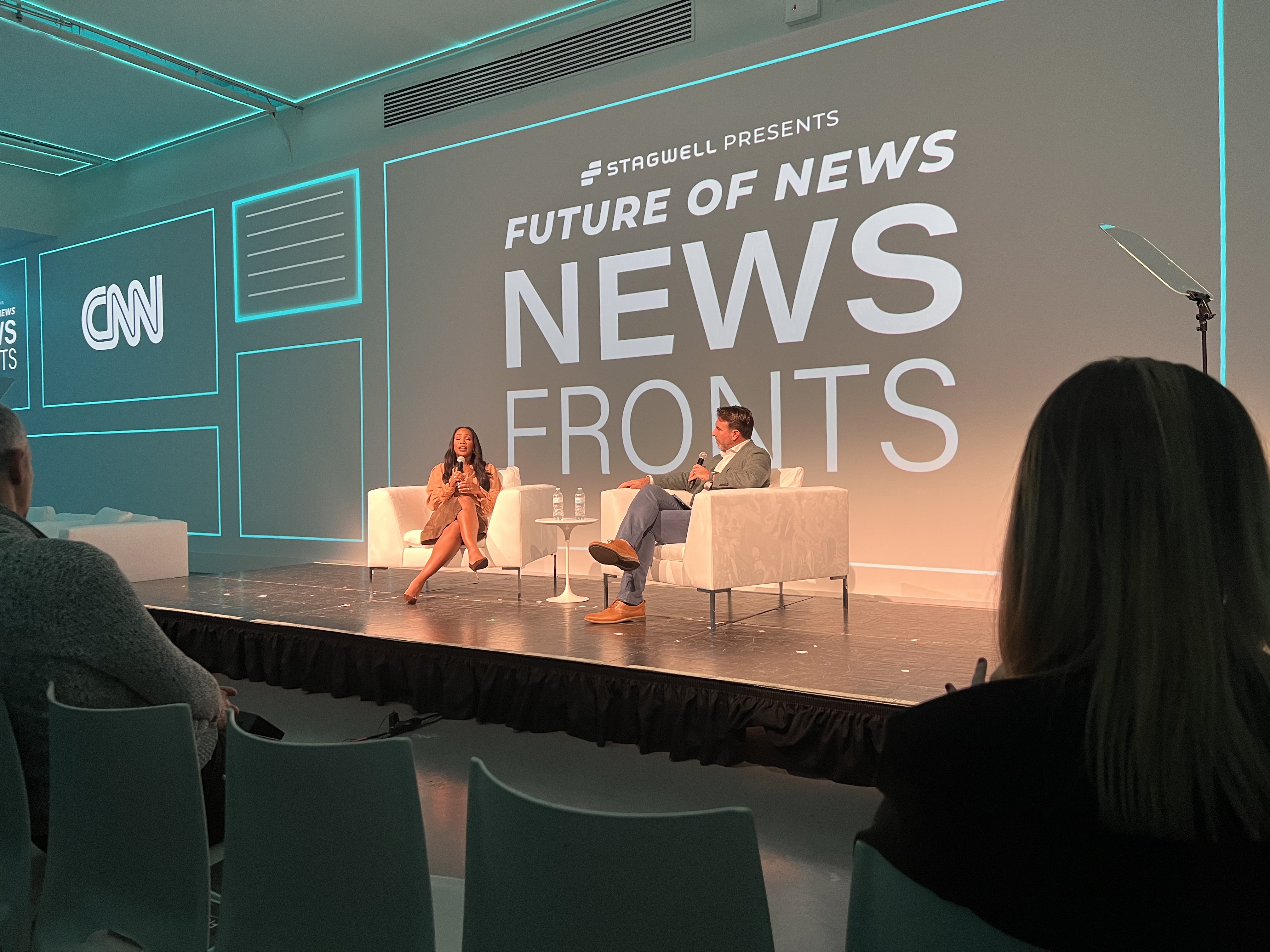
I spent much of yesterday on Manhattan’s West Side, where a hundred or so media types gathered to discuss The Future of News. It was a glitzy event staged by Stagwell, one of the more forward-thinking marketing outfits, and happened at a place called Lavan Midtown. It was an appropriate setting— so futuristic, with its white walls in permanent motion, swimming with happy colours alongside the brand names of participants: NBC, The Financial Times, Axel Springer, Gannett, Axios . . . 

 I have some thoughts about the event, and then a confession

The sessions were headlined with the usual upbeat, somehow meaningless, titles:

REBOOTING THE NEWS PRODUCT FOR THE NEXT GENERATION

TURNING ATTENTION INTO IMPACT

Eager speakers hopped around the stage, ticking off their farseeing ideas and innovations, all of them delivered with a blizzard of jargon and hardly a blink of doubt. We heard about the magic of new technology and the still unmeasured wonders and possible dangers of AI. It was impossible to know which of these dazzling blueprints for the future might work best. 

The striking thing for me, amid the non-stop waves of bright-eyed optimism, was a word that echoed through the whole day.

TRUST

Speaker after speaker repeated this word, though mainly to emphasize the “trust” they claimed for their particular brands.

No one mentioned that the news media is suffering a famine of trust; that a Gallup poll was released only two weeks ago showing that trust in mass news media is plunging; that in the 1970s it was at 70 percent of the population and had now plunged to a mere 28 percent. 

That’s easy to understand, put in the context of a world flooded daily through social media with a crazy avalanche of lies and conspiracy theories; when a huge percentage of young people rely on unmonitored posts for their “news”; when powerful people pour scorn on the traditional media. It’s a truism that lies repeated again and again can turn into truth in the heads of many.

The man from Axel Springer said it best yesterday: “Misinformation spreads faster than the truth.”

That’s not a new thought . . . Jonathan Swift said the same thing more poetically: “Falsehood flies, and truth comes limping after it, so that when men come to be undeceived, it is too late.”

Swift wrote those words more than three hundred years ago, when print was a wonder of the world, so it’s not a new problem. But he could never have imagined today’s unending torrent of deceit.

Healthy societies are held together by a chain of trust and forbearance, the readiness to tolerate their differences. This chain can be threatened by mad and malign liars, especially when those liars include people in positions of great power.

I have spent decades in the news industry and left that meeting with feelings of hope and apprehension. Hope that their rosy plans bear fruit for them all, that they can rebuild the trust in their truth; and apprehension at the formidable hurdles awaiting them.

Finally, my confession. I have spent decades in the news business and cannot count the number of events such as this that I have been required to sit through. I remember in the mid-1990s, when one presenter spoke with such shining confidence about the durable future of printed newspapers that the audience cheered him.

That speaker was me, so I know what it’s like to get it wrong.

*I’m about to publish a novel, Dying Days, that imagines the catastrophic consequences of growing antagonism towards news media. It’s far-fetched fiction, I hope, although the author Jeffrey Archer read it and wrote “it’s an original story told with frightening conviction . . . Could it happen?” ORDER ON AMAZON NOW

THE COMEDY THAT’S TOO TRUE TO BE FUNNY

26 Sep

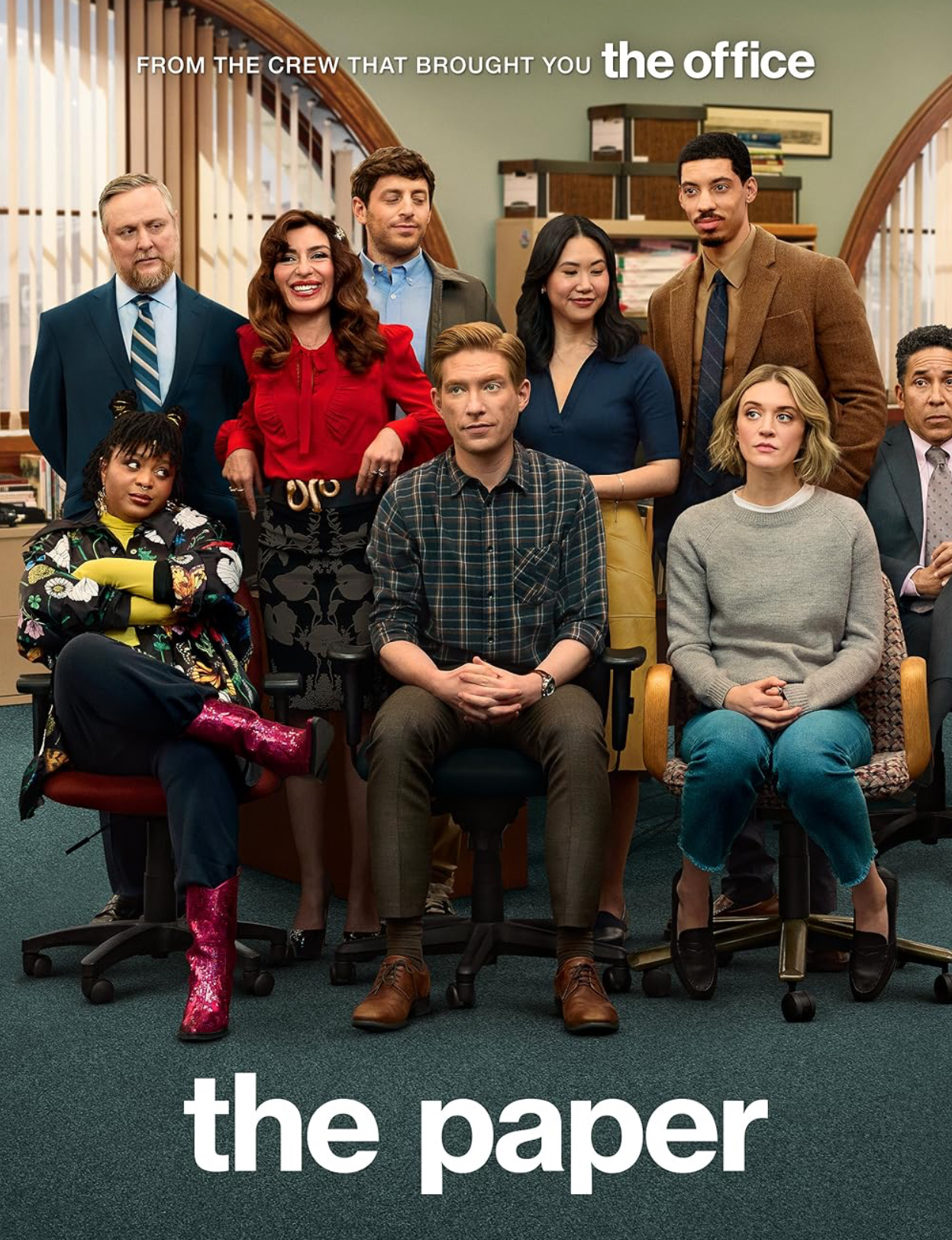
There’s a new comedy streaming on Peacock that doesn’t make me laugh. It’s too true to be funny.
It’s called The Paper and it’s about a newspaper. The unfunny twist is that it’s about a typical local newspaper in the 21st century.
One of the first things you learn in this show is that this newspaper is housed in a magnificent building in Toledo, Ohio, with its name engraved in huge letters on the wall above the grand entrance — The Toledo Truth Teller.
Then you discover that the miserable remains of The Truth Teller are crammed into a few square feet of this vast building. All The Truth Teller’s grandeur is lost; the rest of the building is occupied by the paper’s new corporate owner, which makes its real money selling . . . toilet paper. To double up on that belly laugh, the idealistic new editor-in-chief arrives in the office after quitting his previous job. He was a toilet paper salesman.
The only real journalist on the Truth Teller is a young woman who spends her life staring at a screen to cut and paste agency copy into the paper. The ad sales guy and the office bean counter are sent into the streets in desperate hunts for local news. There’s a click-bait editor putting up stories like You’ll Never Guess How Much Liam Neeson Tipped His Chauffeur. This scoop arrives online, a couple of sentences at a time, between endless ads, before the breathless moment arrives when the amount is revealed.
Everyone reading this who has lived with newspapers knows what I’m writing about and understands how painful it is to watch. The Paper is an only slightly satirical picture of the real circumstances facing hundreds of local newspapers — those, that is, that still survive in a changing world.
The Paper does dig up some real humor at the expense of the depressing truth that newspapers are a vanishing thing. A lot of newspaper people — Brits at least — laugh in the way their parents and grandparents found humor in the Blitz.
A few great newspapers will survive. We might even keep calling them newspapers; other terms — cut, paste, and cc — live on in the digital world, beyond their original meaning. But we won’t be able to hold these newspapers in our hands.
When this series runs its course, you can imagine the final episode; the entire cast troops out of the office, with their possessions in boxes, and the doors are locked forever behind them.

REMEMBER THE PRESS MOGULS

20 Sep

I’ve been reading again an article I wrote a while back for the Wall Street Journal. The Journal editors wanted me to write about the Press barons that most fascinated me. I chose books about five: William Randolph Hearst, Henry Luce, Robert Maxwell, Katharine Graham, and Rupert Murdoch. Declaration of interest — Murdoch was my boss for fifty years. Of the other four, I met two: Maxwell and Graham.

It felt strange looking at them again, kind of archaeological. The Press mogul is not extinct yet; Rupert Murdoch is 94 and still making calls to his farflung editors. But there will be no more to replace any of them, none to exercise the great influence they once enjoyed. They are being rendered extinct by a changing world.

They were almighty in their day and looking back at these books provided a mixture of shock and nostalgia: the power of them, the courage, madness, ego, even villainy in some cases. They were born and prospered in an age when print sat at the pinnacle of the pyramid in communications; when a tiny number of people led by them decided what would inform and entertain the multitudes beneath. Now the pyramid is inverted and anyone with a five-ounce gadget in the palm of their hand can access a virtual infinity of entertainment and information.

It’s popular to decry the power the moguls enjoyed, and sometimes abused, and to celebrate their disappearance. True, some of them were plain crooks — the example in my list is the malign Robert Maxwell. But it would be hasty to be glad seeing the back of them. They might sometimes have abused their power; but they also had the wealth and strength to withstand the bullying of mighty corporations whose corruption they exposed, and to fight back against the attacks of governments when their policies went off the rails.

There are many more voices in the world of news now, but their power has been atomized. They are small, and many lack the ability to stand up to the worlds of business and political power that it is their job to and confront expose.

Nor can millions of consumers faced with a blizzard of alleged “news” easily decide what to believe; and people who aren’t sure what to believe are easily misled.

The great press moguls had the power to stand up to other great powers and we should worry that the balance is tipping away from news media and in favor of politicians and the rich and powerful. When the balance of power goes awry bad things happen; there’s centuries of evidence to prove that.

THE UNCROWNED KING

By Kenneth Whyte (2009)

The story of William Randolph Hearst’s early years, before his empire was built. It is the late 1800s, and newspapers are the first mass media. Young Will Hearst, still a rolled-sleeve editor, arrives in New York from San Francisco to take on Joseph Pulitzer, overlord of the American press. It’s the beginning of “the most spectacular newspaper war of all time.” Kenneth Whyte brings to life these pioneering days of febrile dramas, dirty tricks, wild stunts and pure genius. His book is also an effort to rescue Hearst’s reputation. Rather than being “lunatic, diabolical . . . and Satanic,” Hearst was, Mr. Whyte argues, responsible for journalism that was nuanced and balanced. The most famous Hearst story is debunked: There is no good evidence that he sent a telegram telling an illustrator before the Spanish-American War: “You furnish the pictures, and I’ll furnish the war.” To equate the yellow press of Hearst and Pulitzer with today’s supermarket tabloids, we’re told, is wildly off-target. The former were “far from being shady, squalid or trivial” and were staffed with “first-rank journalistic talent—men of high purpose.”

THE PUBLISHER

By Alan Brinkley (2010)

Henry Luce was 24 when he co-founded Time magazine. It was 1923, and Time was that radical new thing, a “news-magazine” aimed at distilling the events of a complicated world for a middle class coping with the pace of modern life. It established a national presence that no newspaper had achieved. Luce later went on to further successes with Life, Fortune and Sports Illustrated. The shy but ambitious missionary’s son, whose childhood stammer returned under stress, brought his father’s messianic zeal to his propensity to lecture America about the nation it should be. America, he wrote, must lift mankind “from the level of the beasts to what the Psalmist called a little lower than the angels.” Like many media owners before him and since, Luce was bent on advising the leaders of his day—but was usually ignored. He had close relationships with Eisenhower, Kennedy and Johnson, but they rarely took his advice. Luce, on the other hand, “often adjusted his own views to sustain his relationship with people he considered important.”

MAXWELL: THE FINAL VERDICT

by Tom Bower (1996)

Robert Maxwell owned the New York Daily News, the London Daily Mirror, Macmillan Publishers, and much more. He was also a crooked blowhard with the business style of a runaway train, who flew inevitably off the tracks. Maxwell would have spent years in prison, but for the unfortunate fact he was dead when his crimes were discovered. When the consequences of his misdeeds were about to crash down on him in 1991, he fell mysteriously off his yacht into the Atlantic.  Maxwell was exposed as an epic liar and thief who stole a fortune propping up his crippled businesses, and pillaged £400 million from his employees’ pension fund. Bower was Maxwell’s chief tormentor and lawyers managed to ban an earlier version of this book from every bookstore in Britain. This volume was Bower’s victory lap after years of harassment doing battle with Maxwell’s hired hands. It is the story of a poor Czech immigrant who won election to parliament and committed his crimes even as many suspected something very fishy about him. It is also about the eternal riddle of how rogues, with charm and intimidation, cast spells over others. Bower’s explanation might be universal: “Maxwell prospered because hundreds of otherwise intelligent people wilfully suspended any moral judgment and succumbed to their avarice and self-interest.”

MURDOCH

By William Shawcross (1992, updated 1997)

Rupert Murdoch’s empire has exploded in size, and shrunk again, since this book was first published. Twenty-five years ago, his company’s foundation and Murdoch’s first love — newspapers — were at their apex. The expression “information age” was just becoming fashionable and the age of Press barons had yet to yield to a mightier generation of communication moguls whose technology would unleash an infinite torrent of information and entertainment that would make newspapers puny. Murdoch, now the last global Press tycoon, was in his scrappy, risk-taking prime. He was a roaming conqueror, setting his camp in Sydney, London, New York, Los Angeles, and beyond. Usually his campaigns yielded riches, but not always. This book is a vivid account of Murdoch’s roots and of his relentless, mercurial style, with an affecting description of the invincible mogul at his most susceptible: he was mired in a debt crisis and his survival depended on one phone call to a Pittsburgh banker — “It’s not a pretty sight to see a great man like that. He was so vulnerable. One phone call could mean the end of his whole life’s work…. He was visibly shaking, but he didn’t go crazy.” 

PERSONAL HISTORY

By Katharine Graham (1997)

Katharine Graham was an accidental mogul, a self-confessed downtrodden wife, who had power thrust upon her when her tormented husband Philip shot himself.  She found herself — meek and inexperienced — succeeding him as  publisher of The Washington Post, and she rose to make some of the famous calls of 20th century American journalism. Graham approved publication of the Pentagon Papers and stood behind Ben Bradlee and Woodward and Bernstein through Watergate. Aside from this book’s close-up account of historic events, Graham writes with startling frankness about the oppression she suffered from her bipolar husband and how her family diminished her. Philip’s derision “gradually undermined my self-confidence almost entirely”, she writes. He was “tearing me down … I increasingly saw my role as the tail of his kite”. When she gained weight, he called her “Porky”. Graham’s father, Eugene Meyer, had bought The Post in a bankruptcy sale. He gave her some voting shares, but far more to Philip because “no man should be in the position of working for his wife”. Graham confesses: “I not only concurred but was in complete accord with this idea.” Her transformation into the admired and feared first lady of the Beltway is a heartening story.

CONFESSIONS OF A MURDOCH TOADY

29 Jul


by Les Hinton

I did a brave thing recently. I volunteered to appear in the BBC epic Rise of the Murdoch Dynasty to speak positively about Rupert himself.

For years, I had uniformly declined to help with TV shows and books about him. The approaches from producers and authors were always amusing — “It will not be a stereotypical portrait; we want it to be a thoughtful and insightful profile” …. “It’s the right time to produce an historical document” …. “Our ambition is to make the definitive series on Rupert Murdoch”. Yeah yeah.

But this time I accepted. The reason was self-serving: my memoir was out in paperback (buy it now — The Bootle Boy: an untidy life in news. Amazon, £9).

Two bright young men interviewed me over three days in Manhattan and London. I posed for them in a park across my street; they filmed me looking meditatively out my window; and I did my best to talk about Rupert — his trials, triumphs, and his blunders — without coming across too much as a blindly loyal lifelong fanboy. I worked for him fifty years and trust me there were plenty of warts.

They asked tough questions and sometimes I regretted my answers; good interviewers make you do that. I’m not complaining.

They maybe took a few things I said out of context, but who among us in the media hasn’t been rightly accused of that?

I didn’t think they were working on a paean. I knew they wouldn’t be going out of their way to reveal him as a generous, gentle, misunderstood genius.

They lined up the usual hit squad, people who’ve been repeating the same things for a decade at least.

There were Max Mosley and Hugh Grant, whose altruistic worries about the conduct of the tabloid press might be heightened by revelations of their own famous indiscretions.

Dennis Potter, the playwright who’s been dead a quarter of a century, was brought back to life to remind us he named his fatal cancer Rupert.

Alastair Campbell told us again how he had to wash his mouth out with soap every time he was nice to the Murdoch Press.

And Tom Watson, the former Labour MP whose political career evaporated last year for reasons too distracting to enter into here, repeated his favourite line about the company being a mafia operation.

Watson also got personal with me, describing me as beneath his contempt, which I’m fairly confident put me in excellent company.

He was provoked into saying this by my suggestion he was motivated to orchestrate a political storm over phone hacking because of Labour’s distress at The Sun for rejecting the premiership of Watson’s hero and puppet master Gordon Brown. I’d always thought it was a point of pride for him.

Defenders were thin on the ground in this three-hour epic. The most prominent among them was an over-excited Nigel Farage, which struck me as mischievous casting.

My own contribution differed from others in acknowledging some of Murdoch’s non-fiendish traits.

There wasn’t much else positive said about him.

He’s not perfect, far from it, but they might have ticked off a few things on the plus side of the ledger to punctuate their list of crimes. Such as how he rescued British newspapers from an early death in the 1980s and then upended the suffocating duopoly that ruled broadcasting before the advent of Sky.

At the end of the final episode, there’s a clip from a Murdoch interview in which he is sceptical about the causes of climate change. Straight after that, the show cuts to a raging inferno — an Australian bushfire, I think.

The implication was clear: on top of everything else, Rupert Murdoch was now guilty of setting the world on fire.

No doubt the Murdoch loathers loved it.  For them, tales of Rupert the demon are like favorite bedtime stories. They’ll listen to them over and over.

For my appearances, the accolades from them poured in on Twitter —  “lickspittle …. bag carrier…..shoe polisher….lying twat…… a f****** worm”

But I don’t know anymore about the BBC. She’ll be 98 years old in October and the old girl’s age is beginning to show. It’s a sure symptom of cranial decay when someone keeps boring us with the same story.

The BBC has been updating its version of the Rupert Murdoch story for decades. In their version, Murdoch is Britain’s default demon and the source of just about everything that’s gone wrong in this country in the last five decades or so.

The BBC can’t help itself. They must see it as a solemn duty to keep returning to this story to reset the nation’s moral compass lest it forget the devil among them.

But some understanding is called for.

While the BBC loathes Rupert Murdoch, it’s fair to say the feeling is entirely mutual.

Diary of a book tour: 1

6 Apr

The Last Great Beast of a Mighty Line

6 Apr

Published March 2018 in the British Journalism Review @TheBJReview

 by Les Hinton

The days of the autocratic editor are numbered: newspapers need to look elsewhere for the manic energy that fuels great journalism

It was a brisk autumn evening when we arrived at the point where Ave Maria Lane meets Amen Corner, and walked into the cobblestoned courtyard of Stationers’ Hall, home of the Worshipful Company of Stationers and Newspaper Makers, whose origins trace back more than 600 years. We were a couple of minutes from St Paul’s Cathedral where tradesmen, in the days even before print, offered their manuscripts and were named stationers because of the “stations” at which they worked.

It is always an out-of-time experience visiting Stationers’ Hall – I’m sure I saw a cat, a Dick Whittington cat, glide through the courtyard shadows – and that sense of the bygone gave special meaning to the reason we were there. The symbolism was almost too good to be true.

Our host was Jonathan Harold Esmond Vere Harmsworth, the fourth Viscount Rothermere, of Hemsted in the County of Kent, and only remaining real-life hereditary lord of the press on earth. Jonathan Rothermere might not be what you would imagine of a press lord, with the gangly, tentative way he moves and the face that seems too gentle for the role; but, in the two decades since inheriting his position, no national newspapers have done better than those he controls.

Those last few lines are a compliment but, as every reader of this journal knows, it is a relative kind of praise. Rothermere’s newspapers, and those of his un-aristocratic rivals, are in existential trouble. Great newspapers are dying or fading away, and the long genetic link going back to those primitive manuscripts sold on the steps of St Paul’s, and Wynkyn de Worde, Fleet Street’s first printer, is going through an historic upheaval.

The viscount’s grand party that night, beneath the gaudy livery flags and ancient stained-glass images of Shakespeare and Caxton, was a homage to one man, but it also felt like a requiem.

Paul Dacre is one of the last mighty Fleet Street editors and we were there to honour a miraculous accomplishment: Dacre had held down his job as editor of the Daily Mail for 25 years. As Rupert Murdoch, an untitled titan, said that night in a flickering video tribute from California, even the fabled Arthur Christiansen of the Daily Express only managed 24 years.

There won’t be many more evenings such as this. Paul Dacre – just like his ennobled boss – is among the last of his breed. The big editors of Fleet Street will soon be gone forever, extinct as the linotype and the clattering typewriter and the newsboy’s cry.

There will be other editors, but as the shapeshifting world of media diminishes the importance of Fleet Street’s great newspapers, none will assume the same power, admiration, and notoriety.

There is no editor left in Fleet Street who could command the attendance of that night. Theresa May was there, at the top table alongside Lord Rothermere. At the next table was her husband Philip, with the familiar radiating beam he somehow manages, no matter how dire his wife’s most recent predicament. He was on the right of Claudia, the viscountess.

On the other side of the viscountess was the guest of honour himself, approaching his 70th year, with an elegant stoop to show for those years bent over hard copy and page proofs, a mixture of delight and discomfort as he acknowledged the procession of important people arriving to pay tribute.

There were a dozen or so present or past Cabinet ministers, both Labour and Conservative, although Tories easily won the count. There were peers and MPs, and even once-bitter rivals; Richard Desmond, a shrewd money man who was beating his own retreat from Fleet Street, seemed surprised and pleased to be a guest at his table. Gordon Brown and Michael Howard sent congratulations by video. Incongruously, so did Simon Cowell.

Most of the current standard-bearers of Fleet Street were there, as well as many of its old relics – among the old hands these days, the default topic of conversation being how lucky they were to have departed before the storm struck.

Of the existing editors present, only John Witherow of The Times has the reputation and tenure to compete with Dacre’s. He has been editor either of The Times or The Sunday Times since 1994. In the calmer world of the heavies, editors traditionally hang on longer.

The power of today’s editors has dwindled with the size of their products, and the days may be numbered when politicians will continue to believe that newspapers can determine elections – if they ever could.

When I first became interested in newspapers, there were two television channels, and just about every household in Britain read more than one newspaper every day; in my house, before we had TV, we read newspapers and listened to the radio.

Back then, and in years to come, Fleet Street editors were big beasts, although not all achieved the influence and profile of Dacre.

The aura of strong editors spreads throughout a newspaper, reaching people who are far too junior ever to actually speak to them. I discovered this when I was 15 at a little evening newspaper in Adelaide, where the editor was a well-born man named Rohan Deakin Rivett, the grandson of Australia’s second prime minister. His underlings seemed to channel their boss before every move – “You sure he’s happy with this leader? … That headline will send him crazy … Not another pet story! He’s getting sick of them ….” Later, in Fleet Street, I discovered this kind of anxious compliance is routine.

For King and Cudlipp

I also discovered the power and reputation of some Fleet Street editors. Hugh Cudlipp was the mastermind of the Daily Mirror’s success and influence and, in his day, the country’s most famous editor; David English, Dacre’s forerunner, transformed the fortunes of the Daily Mail when it became a tabloid (coyly, he chose to call it a “compact” and it was launched with the slogan “The Compact with Impact”). English, then Dacre, swept away the Daily Express to become the country’s dominant mid-market newspaper. His Mail might have been a personality cult; some who worked for English adopted his mannerisms. Rod Gilchrist, his features editor, and even Paul Dacre, would emulate his gestures and the strange high pitch of his voice when he was excited.

Larry Lamb of The Sun was brooding and fearsome. When he attempted a smile, and his big lips parted, it was more like a snarl. His slow, lop-sided lope into the big room sent a shiver through us all. His post-dinner beratings of the back bench would be audible to all. The smallest lapse was enough to raise his anger – “Lengthy! Lengthy? What kind of a bloody word is that? What’s wrong with long? … “Initiate? Please! You mean begin.” A first edition with too many failings was known to fly across the subs’ table, dismembering in flight. In the end, he might have developed an overblown sense of his own genius, but The Sun he created – love or hate it – changed the rules of Fleet Street as it became the biggest-selling newspaper in the English language.

Lamb and his leading contemporaries were garlanded with knighthoods and peerages. Knighthoods were lavished among editors, awarded for “services to journalism” or by grateful prime ministers – Lamb, Nick Lloyd, Harry Evans, David English, Peter Stothard. There were also peerages for some – Cudlipp, William Rees-Mogg, Francis Williams. English, already a knight, was due for a peerage in 1998 but died before it could be announced.

While editors received mere life peerages, newspaper proprietors earlier in the last century were routinely enlisted into the aristocracy with the hereditary variety – Jonathan Rothermere’s great-grandfather Harold Harmsworth, his great-uncle Alfred Harmsworth (Lord Northcliffe) and Beaverbrook, Thomson, and Camrose.

It wasn’t as if the press was held in high regard by the establishment in those days. The most famous of all attacks on the press came from Stanley Baldwin in 1931, when he was prime minister and newspapers were giving him a particularly hard time. The press, he said, was guilty of “direct falsehood, misrepresentation, half-truths, the alteration of the speaker’s meaning … What the proprietorship of these papers is aiming at is power, but power without responsibility – the prerogative of the harlot through the ages”. These sentiments are echoed to this day, although never so vividly. And now, as then, politicians who vilify the press still alter their tune when seeking its endorsement.

There were editors of later generations, those I worked for, or with, and over whom I enjoyed, at least technically, some authority.

I never worked on newspapers alongside Kelvin MacKenzie or Andrew Neil, a lucky break for me, given their hatred of interference; they accepted Rupert’s, of course, but never joyfully. Andrew and I did work together briefly in New York, developing (without success) a network news show. Like his days as editor of The Sunday Times, he approached everything with fierce gusto and lack of self-doubt. He sought to remind me each time I walked into his office that the programme’s content was his responsibility alone, even though I was always happy to leave him to it.

In the 1970s, Kelvin MacKenzie arrived at the New York Post as night editor when I was based in Manhattan as a correspondent. The natives found him difficult. He enjoyed abusing a sweet-natured Texan sub-editor by calling him a “Texas toe rag”; it was a while before his victim realised he was being insulted. A Post editor who was senior to Kelvin often could not join the conferences in Kelvin’s office – he would lock it and turn his back to the glass door. Kelvin was a terrorist editor, but not always. In those days, he still knew his place in the pecking order. When Larry Lamb was The Sun’s editor and visited Manhattan, he took a group of us to dinner at a French bistro off Third Avenue, where Kelvin sat all night in awed silence, to everyone’s amazement.

Nostalgia for the Cheese and Mucky Duck

That was before he had the power to make an entire city his enemy, threaten a prime minister with a bucket of excrement, and tell complaining readers that their subscriptions to The Sun would be cancelled.

Even as the sun was lowering on the golden days of Fleet Street, bright stars followed these editors. Piers Morgan’s Daily Mirror restored much of its old brilliance; Stuart Higgins, Kelvin’s successor, who would almost levitate with excitement on big news days, made The Sun as good as his predecessor, at least (David Yelland was out of water at The Sun, a freshwater trout suffocating in the bitter salt tides of a hectic redtop; he might have flourished at broadsheet); John Witherow is the strongest serious daily newspaper editor left standing, and his Times is peerless – I’m sure of that, even through my own bias.

As we left Stationers’ Hall that evening, it was as if we had spent four hours suspended in another age, insulated briefly against the harsh reality waiting outside in the cold autumn night.

Inside, among the newspaper people, there had been a community of spirits I had known since coming to Fleet Street half a century before as an eager apprentice; a crush of hustling, joking, exuberant competitors, the cream of a historic industry with mingling feelings of animosity and admiration towards one another.

How will journalism happen after this, without big newspapers and those at the helm to gravitate around, when more journalists become castaways, working remotely, hermits at their keyboards? Where will the energy come from without the human combustion of a crowded newsroom, with great editors in command?

No one knows, but I’m not giving up hope.

There was dread about the loss of community when newspapers evacuated Fleet Street but, most of all, newspaper people were merely homesick for the pubs and boozy camaraderie.

Newspapers had huddled there for centuries, as the stationers had around St Paul’s even more centuries ago. The technology of printing scattered the stationers; more technology scattered newspapers in the 1980s; and now the technology of algorithms and electromagnetic interaction is scattering journalists from shrinking newspapers to ambitious new ideas.

When technology offers an infinity of entertainment and information in the palm of your hand, the competition for people’s attention is a battle print newspapers cannot win.

There might be much to mourn, but, while the newspaper industry is declining, its purpose never will.

The business models that built the old empires of print are being demolished, and for most newspapers nothing can stop that. Even if the smartest can navigate through the morass to a sustainable digital platform, they are unlikely to return to the profits of the old days.

But the biggest, most universal delivery system ever known is now in place, and there will always be an appetite for good writing and powerful opinions and important information. The new economics of journalism has still to be sorted, but there will always be stories to tell.

Les Hinton worked in newspapers, magazines and television as a reporter, editor and executive in Australia, the United Kingdom and the United States. His memoir – The Bootle Boy: an untidy life in news – will be published by Scribe in May.

@leshinton
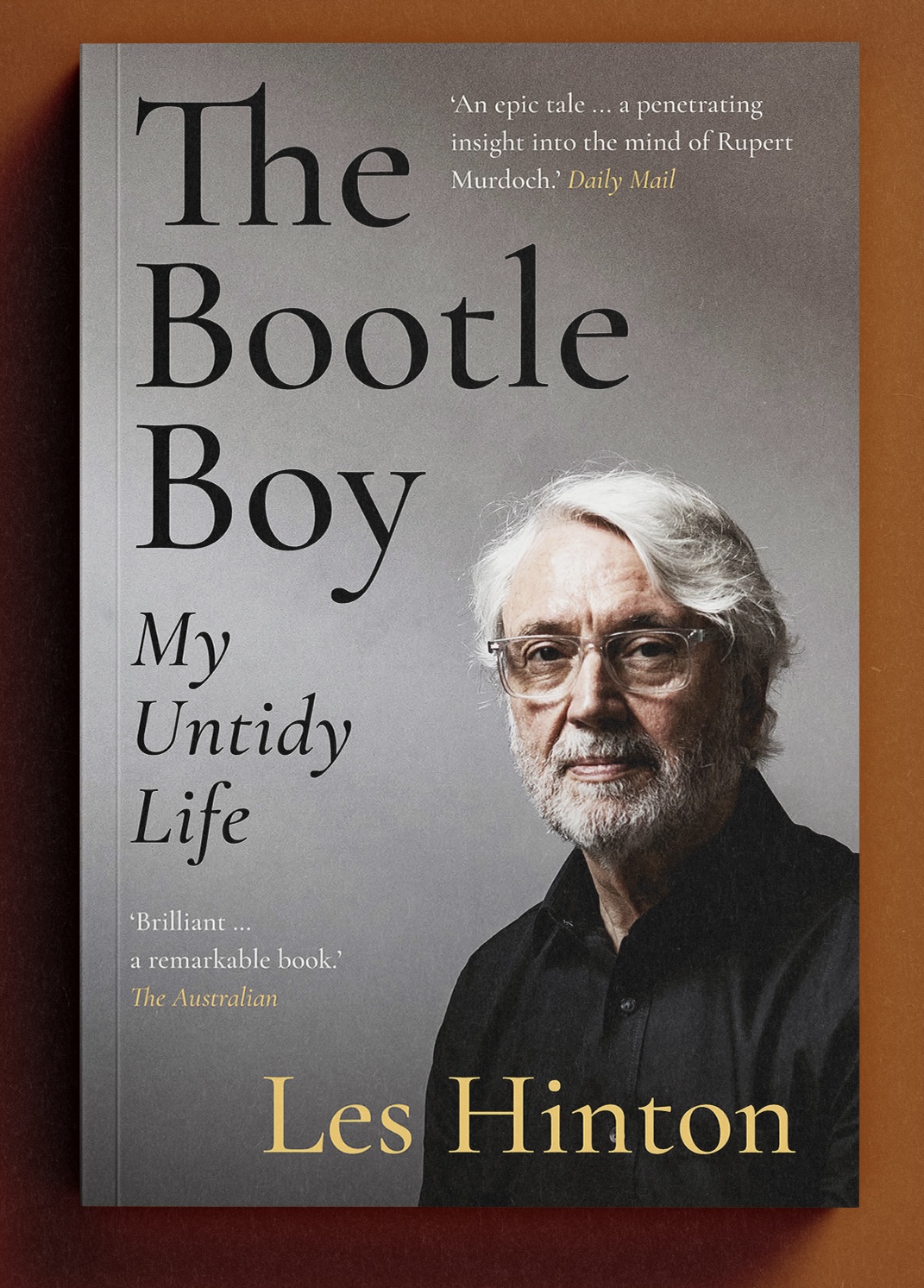
SCRIBE T0 PUBLISH LES HINTON’S MEMOIRS

5 Sep

Scribe UK and Scribe Australia are delighted to announce that next summer they will publish The Bootle Boy: An Untidy Life in News by Les Hinton, who was Rupert Murdoch’s right-hand man over five decades.

Born during the war in the Liverpool dockside district of Bootle, Les came from a teeming and lively family of bakers, cooks, dockers and theatre managers. He had a peripatetic childhood thanks to his father’s exotic Army postings in the twilight of the British Empire, culminating in the family emigrating to Australia. At 15, Les landed a job as a copy boy at an Adelaide newspaper owned by the rising star of the Australian press, Rupert Murdoch. The rest is media and business history, as Les rose to become integral to Rupert’s business.

Publisher Philip Gwyn Jones says; ‘Les was a keystone in the construction of an ever mightier media empire that came to encircle the globe, midwife a media revolution or two, and play a very significant role in governmental policy and public opinion on four continents. Les was at the mogul’s side for five fascinating decades — an experience he recalls and illuminates with great flair and gusto in this riveting memoir. It is so winningly honest and undeluded, and there is plenty of meat in it about politicians and journalists and pop stars and the Davos world alike, and of course about Murdoch, all delivered most tastily cooked. Amongst its other virtues, this might just be the most thoroughly revealing portrait of The Digger we are ever likely to get. It is not a mud-slinging or revenge-taking book. It is far more interesting than that, as a portrait of how great businesses are built, run and grow, and how one man can come to control the flow of news down so many channels. Not least because of its evocative depiction of the challenges faced by the ordinary working families of Britain during the war and during the austerity and end of empire that followed it, it is if anything most reminiscent of This Boy by former Labour Minister Alan Johnson, and will, we think, appeal to that book’s thousands of fans.’

Les says; ‘I wanted to tell a story of change and vanishing worlds: struggling, proud Bootle, and the bulldozed neighbourhood where I was born; a childhood of travels through the dying British Empire, where everywhere I went the sun was setting on it; the wild, often nutty, world of shapeshifting global media; the mighty empires of print that were swept away, to become creaking supertankers lost in the spray of a sleek fleet of algorithm-fuelled speedboats. Over fifty years, I met a lot of people and saw a lot of things.’

‘Rupert Murdoch was a big part of my working life and this book contains my version of the truth about him. Rupert could be hell to work for and he earned many of his enemies. He’s a driven businessman with heavy boots who bruised a lot of people. But, love or hate him, he’s an authentic colossus. I saw him at all angles: brilliant, brutal, and often – to the surprise of many – extraordinarily kind.’

Philip Gwyn Jones at Scribe acquired UK, EU & Commonwealth rights in the book from Emma Parry at Janklow & Nesbit US, which retains North American, audio, broadcasting and translation rights.