Tag Archives: media

HOW WRITERS REAP THE HARVEST OF THEIR LIVES

14 Nov

I’ve spent my career as a fresh-faced reporter, a travelling correspondent, an editor, and as an executive responsible for huge media companies. I enjoyed it, and learned a lot; but what I didn’t realise until recently was something else it was training me to be.

I had already written a memoir called The Bootle Boy and the research had been easy. I wrote about my life and experiences in chronological order, looking back now and then at old diaries, calendars, and newspaper clippings to check my memory.

After that, I wanted to try fiction, which is a whole other thing, and, I discovered, much more difficult. 

Thinking up the story; inventing characters; developing the rise, fall, and climax of the story. All this turned out to be far more difficult than I had dreamed.

But what I hadn’t realised was how built-up lessons of my life would help rescue me.

Writers of fiction, as many readers here will be aware, depend heavily on their lived experience. That’s what feeds their imagination. To give their work authenticity, they infuse what they write with the true dreads and joys of the life they’ve lived. Not literally, of course, but to summon the glowing moments of happiness they have known; or the sadness of a loved one’s death; the romance gone wrong; the betrayal of someone you trusted, and to use their imagination to apply these experiences to create wonderful and terrifying moments in their fiction. 

The richness of a life, linked with a fertile imagination, is the foundation of all fiction. I can imagine the above words will be like teaching some of you to suck eggs. But I’m new at this and want to go on to explain what it means to me; how a life face to face with the extreme tragedy and beauty of human existence can be a treasure for a writer.

Let me tell about someone who has seen the highest and lowest of life:

He has been with lottery winners celebrating their millions; with the destitute and homeless and drug addicted; sat in court as a black-capped judge delivered the sentence of death.

He has stood by the piled-up, rotting corpses of massacred women and children in a war zone; walked through the horrifying remains of what was the world’s worst air disaster; survived an IRA bomb.

He has been drunk in a Manhattan punk bar with Johnny Rotten; received a playful punch in the stomach from Paul McCartney; made the late Queen Elizabeth laugh at his jokes.

He has met presidents and prime ministers; stared from two feet away into the cold eyes of Benjamin Netanyahu, sat alone with an anguished Tony Blair as he prepared to send his country to war; been the object one-to-one of the overwhelming persuasive power of Margaret Thatcher; and a victim of the easy, body-pressing charm of Bill Clinton.

He has worked in the fantasy world of Hollywood among the movie stars and egocentric moguls. Sat at a breakfast cafe next to Stephen Spielberg; watched Meryl Streep stroll by with a baby on her hip; lived next door to O J Simpson at the time he may, or may not, have murdered his wife and her lover.

This someone I’m writing about, you will have guessed, is me and that list represents a fraction of the life I’ve lived. It’s part of the inventory of my life and a treasure that means I should never run out of the ideas a fiction writer needs.

I’m not the first journalist inthis position: Ernest Hemingway, Evelyn Waugh, Geraldine Brooks, Michael Frayn, Frederick Forsyth . . . I could go on, there are many more, and I’m definitely not comparing myself with all that brilliance.

My point is that, if you’re a journalist long enough, all human life will pass your way. Some of it is tough, unbearable sometimes and the stuff of terrible dreams, but, boy oh boy, it’s great raw material if you want to write fiction.

My book Dying Days (Whitefox, $9.99 on sale here https://mybook.tMyDyingDaysbooko/ ) is about the dying days of newspapers and a mysterious group intent on the murder of Press barons and their editors.

It is entirely fictitious, more or less. There’s a prime minister who “no matter how serious things were, a perpetual expression of amused indifference seemed to play on his face.” But it’s not Boris Johnson. This PM bites his fingernails; but it’s not Gordon Brown.

There’s a nonagenarian Press baron and “all the stresses and strains and dirty tricks of his long life were carved deep into his war-torn face” … but it’s definitely not my old boss Rupert Murdoch, far from it.

There’s another Press baron who’s “a caricature of his bawdy newspapers . . . an alien life form unreached by everyone else’s ideas of civility and social convention.” Well, I admit having Robert Maxwell in mind when writing that.

There are many the other characters, foul and fine people, and I know there’ll be others who’ll say of them “ah, that’s so and so.” But they’ll never be right, not completely

 It’s almost all made up. None of it is absolutely true. But it does draw from the rich harvest of the life I’ve had.
THE TRUST HUNT

17 Oct

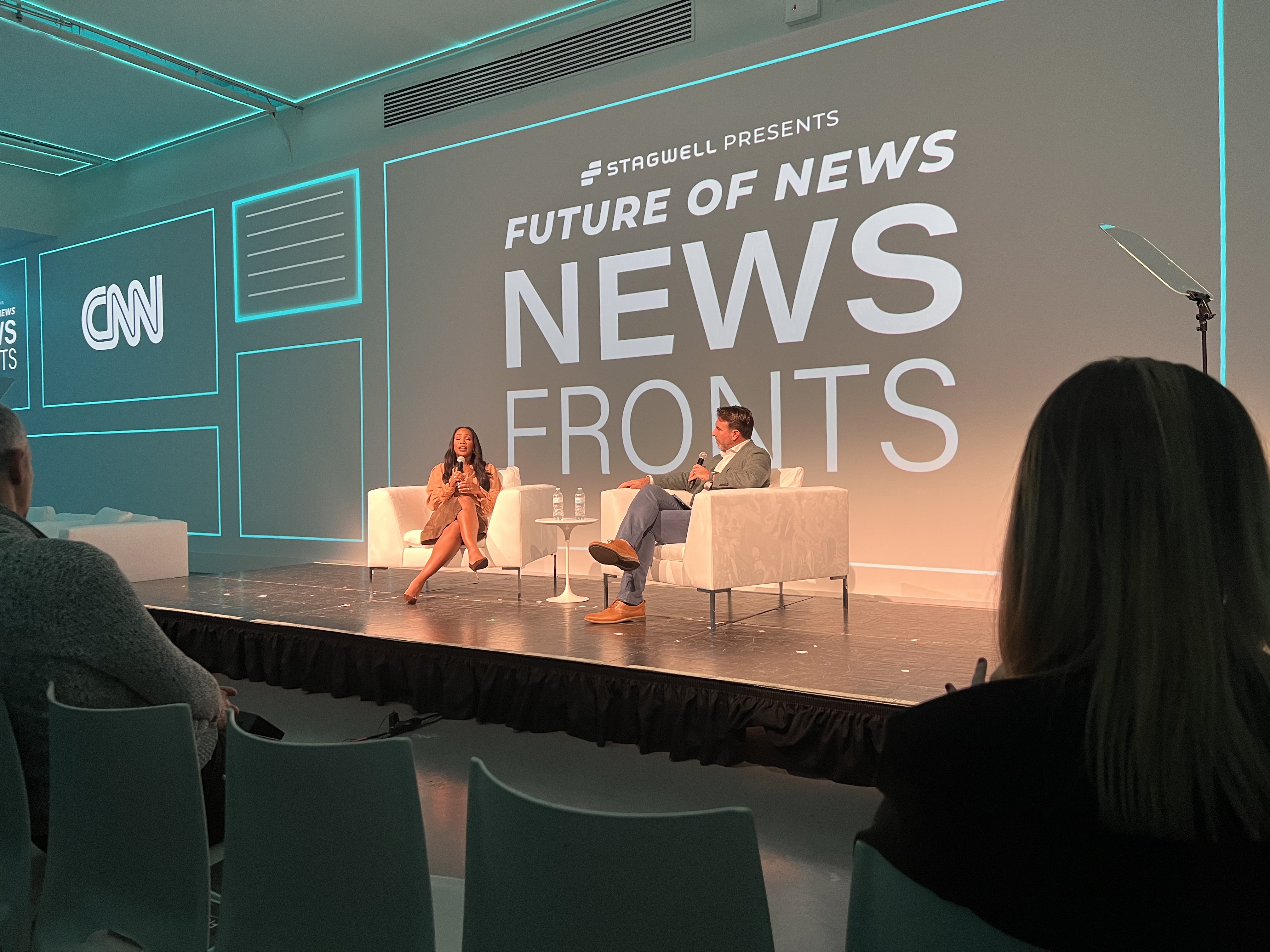
I spent much of yesterday on Manhattan’s West Side, where a hundred or so media types gathered to discuss The Future of News. It was a glitzy event staged by Stagwell, one of the more forward-thinking marketing outfits, and happened at a place called Lavan Midtown. It was an appropriate setting— so futuristic, with its white walls in permanent motion, swimming with happy colours alongside the brand names of participants: NBC, The Financial Times, Axel Springer, Gannett, Axios . . . 

 I have some thoughts about the event, and then a confession

The sessions were headlined with the usual upbeat, somehow meaningless, titles:

REBOOTING THE NEWS PRODUCT FOR THE NEXT GENERATION

TURNING ATTENTION INTO IMPACT

Eager speakers hopped around the stage, ticking off their farseeing ideas and innovations, all of them delivered with a blizzard of jargon and hardly a blink of doubt. We heard about the magic of new technology and the still unmeasured wonders and possible dangers of AI. It was impossible to know which of these dazzling blueprints for the future might work best. 

The striking thing for me, amid the non-stop waves of bright-eyed optimism, was a word that echoed through the whole day.

TRUST

Speaker after speaker repeated this word, though mainly to emphasize the “trust” they claimed for their particular brands.

No one mentioned that the news media is suffering a famine of trust; that a Gallup poll was released only two weeks ago showing that trust in mass news media is plunging; that in the 1970s it was at 70 percent of the population and had now plunged to a mere 28 percent. 

That’s easy to understand, put in the context of a world flooded daily through social media with a crazy avalanche of lies and conspiracy theories; when a huge percentage of young people rely on unmonitored posts for their “news”; when powerful people pour scorn on the traditional media. It’s a truism that lies repeated again and again can turn into truth in the heads of many.

The man from Axel Springer said it best yesterday: “Misinformation spreads faster than the truth.”

That’s not a new thought . . . Jonathan Swift said the same thing more poetically: “Falsehood flies, and truth comes limping after it, so that when men come to be undeceived, it is too late.”

Swift wrote those words more than three hundred years ago, when print was a wonder of the world, so it’s not a new problem. But he could never have imagined today’s unending torrent of deceit.

Healthy societies are held together by a chain of trust and forbearance, the readiness to tolerate their differences. This chain can be threatened by mad and malign liars, especially when those liars include people in positions of great power.

I have spent decades in the news industry and left that meeting with feelings of hope and apprehension. Hope that their rosy plans bear fruit for them all, that they can rebuild the trust in their truth; and apprehension at the formidable hurdles awaiting them.

Finally, my confession. I have spent decades in the news business and cannot count the number of events such as this that I have been required to sit through. I remember in the mid-1990s, when one presenter spoke with such shining confidence about the durable future of printed newspapers that the audience cheered him.

That speaker was me, so I know what it’s like to get it wrong.

*I’m about to publish a novel, Dying Days, that imagines the catastrophic consequences of growing antagonism towards news media. It’s far-fetched fiction, I hope, although the author Jeffrey Archer read it and wrote “it’s an original story told with frightening conviction . . . Could it happen?” ORDER ON AMAZON NOW

REMEMBER THE PRESS MOGULS

20 Sep

I’ve been reading again an article I wrote a while back for the Wall Street Journal. The Journal editors wanted me to write about the Press barons that most fascinated me. I chose books about five: William Randolph Hearst, Henry Luce, Robert Maxwell, Katharine Graham, and Rupert Murdoch. Declaration of interest — Murdoch was my boss for fifty years. Of the other four, I met two: Maxwell and Graham.

It felt strange looking at them again, kind of archaeological. The Press mogul is not extinct yet; Rupert Murdoch is 94 and still making calls to his farflung editors. But there will be no more to replace any of them, none to exercise the great influence they once enjoyed. They are being rendered extinct by a changing world.

They were almighty in their day and looking back at these books provided a mixture of shock and nostalgia: the power of them, the courage, madness, ego, even villainy in some cases. They were born and prospered in an age when print sat at the pinnacle of the pyramid in communications; when a tiny number of people led by them decided what would inform and entertain the multitudes beneath. Now the pyramid is inverted and anyone with a five-ounce gadget in the palm of their hand can access a virtual infinity of entertainment and information.

It’s popular to decry the power the moguls enjoyed, and sometimes abused, and to celebrate their disappearance. True, some of them were plain crooks — the example in my list is the malign Robert Maxwell. But it would be hasty to be glad seeing the back of them. They might sometimes have abused their power; but they also had the wealth and strength to withstand the bullying of mighty corporations whose corruption they exposed, and to fight back against the attacks of governments when their policies went off the rails.

There are many more voices in the world of news now, but their power has been atomized. They are small, and many lack the ability to stand up to the worlds of business and political power that it is their job to and confront expose.

Nor can millions of consumers faced with a blizzard of alleged “news” easily decide what to believe; and people who aren’t sure what to believe are easily misled.

The great press moguls had the power to stand up to other great powers and we should worry that the balance is tipping away from news media and in favor of politicians and the rich and powerful. When the balance of power goes awry bad things happen; there’s centuries of evidence to prove that.

THE UNCROWNED KING

By Kenneth Whyte (2009)

The story of William Randolph Hearst’s early years, before his empire was built. It is the late 1800s, and newspapers are the first mass media. Young Will Hearst, still a rolled-sleeve editor, arrives in New York from San Francisco to take on Joseph Pulitzer, overlord of the American press. It’s the beginning of “the most spectacular newspaper war of all time.” Kenneth Whyte brings to life these pioneering days of febrile dramas, dirty tricks, wild stunts and pure genius. His book is also an effort to rescue Hearst’s reputation. Rather than being “lunatic, diabolical . . . and Satanic,” Hearst was, Mr. Whyte argues, responsible for journalism that was nuanced and balanced. The most famous Hearst story is debunked: There is no good evidence that he sent a telegram telling an illustrator before the Spanish-American War: “You furnish the pictures, and I’ll furnish the war.” To equate the yellow press of Hearst and Pulitzer with today’s supermarket tabloids, we’re told, is wildly off-target. The former were “far from being shady, squalid or trivial” and were staffed with “first-rank journalistic talent—men of high purpose.”

THE PUBLISHER

By Alan Brinkley (2010)

Henry Luce was 24 when he co-founded Time magazine. It was 1923, and Time was that radical new thing, a “news-magazine” aimed at distilling the events of a complicated world for a middle class coping with the pace of modern life. It established a national presence that no newspaper had achieved. Luce later went on to further successes with Life, Fortune and Sports Illustrated. The shy but ambitious missionary’s son, whose childhood stammer returned under stress, brought his father’s messianic zeal to his propensity to lecture America about the nation it should be. America, he wrote, must lift mankind “from the level of the beasts to what the Psalmist called a little lower than the angels.” Like many media owners before him and since, Luce was bent on advising the leaders of his day—but was usually ignored. He had close relationships with Eisenhower, Kennedy and Johnson, but they rarely took his advice. Luce, on the other hand, “often adjusted his own views to sustain his relationship with people he considered important.”

MAXWELL: THE FINAL VERDICT

by Tom Bower (1996)

Robert Maxwell owned the New York Daily News, the London Daily Mirror, Macmillan Publishers, and much more. He was also a crooked blowhard with the business style of a runaway train, who flew inevitably off the tracks. Maxwell would have spent years in prison, but for the unfortunate fact he was dead when his crimes were discovered. When the consequences of his misdeeds were about to crash down on him in 1991, he fell mysteriously off his yacht into the Atlantic.  Maxwell was exposed as an epic liar and thief who stole a fortune propping up his crippled businesses, and pillaged £400 million from his employees’ pension fund. Bower was Maxwell’s chief tormentor and lawyers managed to ban an earlier version of this book from every bookstore in Britain. This volume was Bower’s victory lap after years of harassment doing battle with Maxwell’s hired hands. It is the story of a poor Czech immigrant who won election to parliament and committed his crimes even as many suspected something very fishy about him. It is also about the eternal riddle of how rogues, with charm and intimidation, cast spells over others. Bower’s explanation might be universal: “Maxwell prospered because hundreds of otherwise intelligent people wilfully suspended any moral judgment and succumbed to their avarice and self-interest.”

MURDOCH

By William Shawcross (1992, updated 1997)

Rupert Murdoch’s empire has exploded in size, and shrunk again, since this book was first published. Twenty-five years ago, his company’s foundation and Murdoch’s first love — newspapers — were at their apex. The expression “information age” was just becoming fashionable and the age of Press barons had yet to yield to a mightier generation of communication moguls whose technology would unleash an infinite torrent of information and entertainment that would make newspapers puny. Murdoch, now the last global Press tycoon, was in his scrappy, risk-taking prime. He was a roaming conqueror, setting his camp in Sydney, London, New York, Los Angeles, and beyond. Usually his campaigns yielded riches, but not always. This book is a vivid account of Murdoch’s roots and of his relentless, mercurial style, with an affecting description of the invincible mogul at his most susceptible: he was mired in a debt crisis and his survival depended on one phone call to a Pittsburgh banker — “It’s not a pretty sight to see a great man like that. He was so vulnerable. One phone call could mean the end of his whole life’s work…. He was visibly shaking, but he didn’t go crazy.” 

PERSONAL HISTORY

By Katharine Graham (1997)

Katharine Graham was an accidental mogul, a self-confessed downtrodden wife, who had power thrust upon her when her tormented husband Philip shot himself.  She found herself — meek and inexperienced — succeeding him as  publisher of The Washington Post, and she rose to make some of the famous calls of 20th century American journalism. Graham approved publication of the Pentagon Papers and stood behind Ben Bradlee and Woodward and Bernstein through Watergate. Aside from this book’s close-up account of historic events, Graham writes with startling frankness about the oppression she suffered from her bipolar husband and how her family diminished her. Philip’s derision “gradually undermined my self-confidence almost entirely”, she writes. He was “tearing me down … I increasingly saw my role as the tail of his kite”. When she gained weight, he called her “Porky”. Graham’s father, Eugene Meyer, had bought The Post in a bankruptcy sale. He gave her some voting shares, but far more to Philip because “no man should be in the position of working for his wife”. Graham confesses: “I not only concurred but was in complete accord with this idea.” Her transformation into the admired and feared first lady of the Beltway is a heartening story.