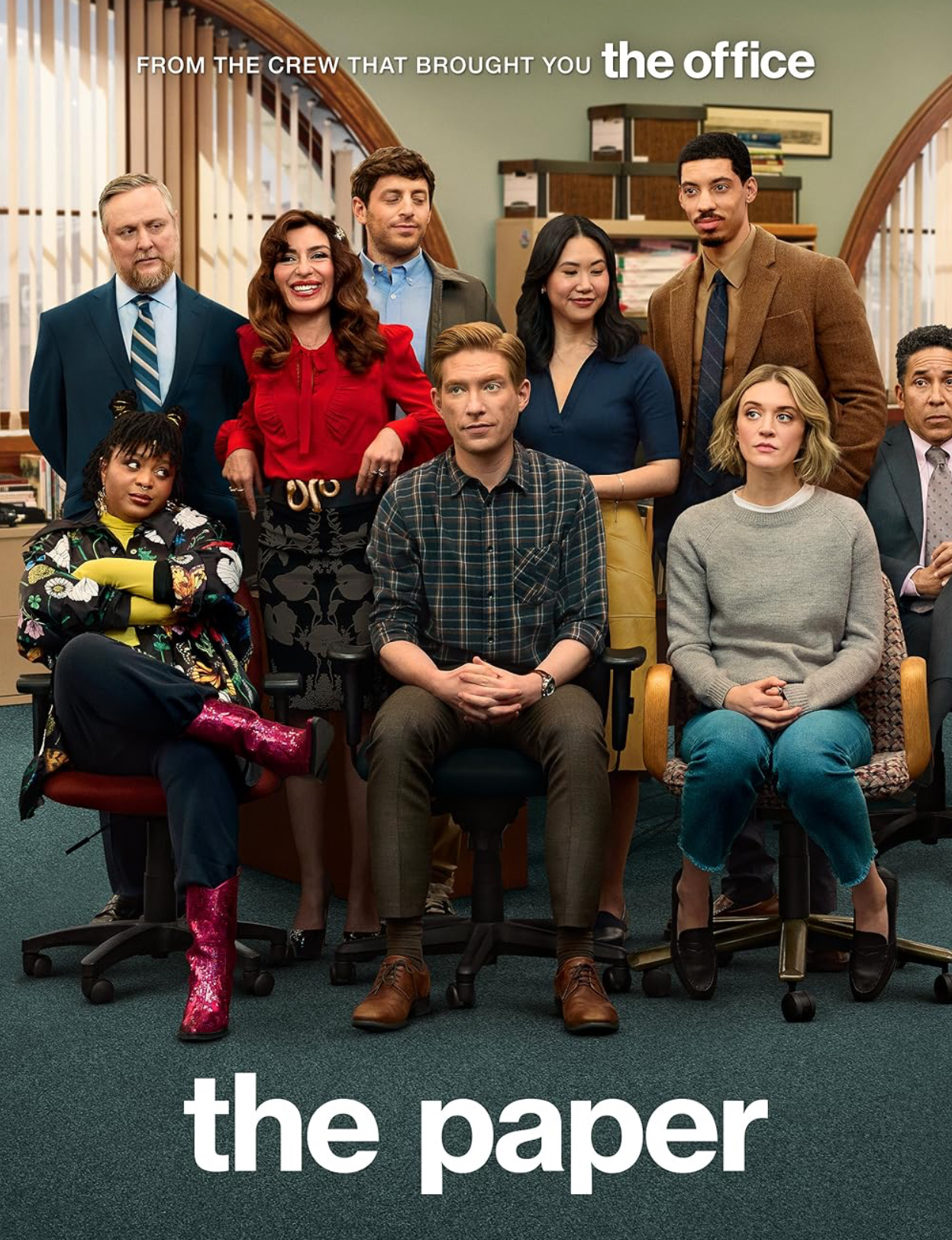
There’s a new comedy streaming on Peacock that doesn’t make me laugh. It’s too true to be funny. It’s called The Paper and it’s about a newspaper. The unfunny twist is that it’s about a typical local newspaper in the 21st century. One of the first things you learn in this show is that this newspaper is housed in a magnificent building in Toledo, Ohio, with its name engraved in huge letters on the wall above the grand entrance — The Toledo Truth Teller. Then you discover that the miserable remains of The Truth Teller are crammed into a few square feet of this vast building. All The Truth Teller’s grandeur is lost; the rest of the building is occupied by the paper’s new corporate owner, which makes its real money selling . . . toilet paper. To double up on that belly laugh, the idealistic new editor-in-chief arrives in the office after quitting his previous job. He was a toilet paper salesman. The only real journalist on the Truth Teller is a young woman who spends her life staring at a screen to cut and paste agency copy into the paper. The ad sales guy and the office bean counter are sent into the streets in desperate hunts for local news. There’s a click-bait editor putting up stories like You’ll Never Guess How Much Liam Neeson Tipped His Chauffeur. This scoop arrives online, a couple of sentences at a time, between endless ads, before the breathless moment arrives when the amount is revealed. Everyone reading this who has lived with newspapers knows what I’m writing about and understands how painful it is to watch. The Paper is an only slightly satirical picture of the real circumstances facing hundreds of local newspapers — those, that is, that still survive in a changing world. The Paper does dig up some real humor at the expense of the depressing truth that newspapers are a vanishing thing. A lot of newspaper people — Brits at least — laugh in the way their parents and grandparents found humor in the Blitz. A few great newspapers will survive. We might even keep calling them newspapers; other terms — cut, paste, and cc — live on in the digital world, beyond their original meaning. But we won’t be able to hold these newspapers in our hands. When this series runs its course, you can imagine the final episode; the entire cast troops out of the office, with their possessions in boxes, and the doors are locked forever behind them.
I’ve been reading again an article I wrote a while back for the Wall Street Journal. The Journal editors wanted me to write about the Press barons that most fascinated me. I chose books about five: William Randolph Hearst, Henry Luce, Robert Maxwell, Katharine Graham, and Rupert Murdoch. Declaration of interest — Murdoch was my boss for fifty years. Of the other four, I met two: Maxwell and Graham.
It felt strange looking at them again, kind of archaeological. The Press mogul is not extinct yet; Rupert Murdoch is 94 and still making calls to his farflung editors. But there will be no more to replace any of them, none to exercise the great influence they once enjoyed. They are being rendered extinct by a changing world.
They were almighty in their day and looking back at these books provided a mixture of shock and nostalgia: the power of them, the courage, madness, ego, even villainy in some cases. They were born and prospered in an age when print sat at the pinnacle of the pyramid in communications; when a tiny number of people led by them decided what would inform and entertain the multitudes beneath. Now the pyramid is inverted and anyone with a five-ounce gadget in the palm of their hand can access a virtual infinity of entertainment and information.
It’s popular to decry the power the moguls enjoyed, and sometimes abused, and to celebrate their disappearance. True, some of them were plain crooks — the example in my list is the malign Robert Maxwell. But it would be hasty to be glad seeing the back of them. They might sometimes have abused their power; but they also had the wealth and strength to withstand the bullying of mighty corporations whose corruption they exposed, and to fight back against the attacks of governments when their policies went off the rails.
There are many more voices in the world of news now, but their power has been atomized. They are small, and many lack the ability to stand up to the worlds of business and political power that it is their job to and confront expose.
Nor can millions of consumers faced with a blizzard of alleged “news” easily decide what to believe; and people who aren’t sure what to believe are easily misled.
The great press moguls had the power to stand up to other great powers and we should worry that the balance is tipping away from news media and in favor of politicians and the rich and powerful. When the balance of power goes awry bad things happen; there’s centuries of evidence to prove that.
THE UNCROWNED KING
By Kenneth Whyte (2009)
The story of William Randolph Hearst’s early years, before his empire was built. It is the late 1800s, and newspapers are the first mass media. Young Will Hearst, still a rolled-sleeve editor, arrives in New York from San Francisco to take on Joseph Pulitzer, overlord of the American press. It’s the beginning of “the most spectacular newspaper war of all time.” Kenneth Whyte brings to life these pioneering days of febrile dramas, dirty tricks, wild stunts and pure genius. His book is also an effort to rescue Hearst’s reputation. Rather than being “lunatic, diabolical . . . and Satanic,” Hearst was, Mr. Whyte argues, responsible for journalism that was nuanced and balanced. The most famous Hearst story is debunked: There is no good evidence that he sent a telegram telling an illustrator before the Spanish-American War: “You furnish the pictures, and I’ll furnish the war.” To equate the yellow press of Hearst and Pulitzer with today’s supermarket tabloids, we’re told, is wildly off-target. The former were “far from being shady, squalid or trivial” and were staffed with “first-rank journalistic talent—men of high purpose.”
THE PUBLISHER
By Alan Brinkley (2010)
Henry Luce was 24 when he co-founded Time magazine. It was 1923, and Time was that radical new thing, a “news-magazine” aimed at distilling the events of a complicated world for a middle class coping with the pace of modern life. It established a national presence that no newspaper had achieved. Luce later went on to further successes with Life, Fortune and Sports Illustrated. The shy but ambitious missionary’s son, whose childhood stammer returned under stress, brought his father’s messianic zeal to his propensity to lecture America about the nation it should be. America, he wrote, must lift mankind “from the level of the beasts to what the Psalmist called a little lower than the angels.” Like many media owners before him and since, Luce was bent on advising the leaders of his day—but was usually ignored. He had close relationships with Eisenhower, Kennedy and Johnson, but they rarely took his advice. Luce, on the other hand, “often adjusted his own views to sustain his relationship with people he considered important.”
MAXWELL: THE FINAL VERDICT
by Tom Bower (1996)
Robert Maxwell owned the New York Daily News, the London Daily Mirror, Macmillan Publishers, and much more. He was also a crooked blowhard with the business style of a runaway train, who flew inevitably off the tracks. Maxwell would have spent years in prison, but for the unfortunate fact he was dead when his crimes were discovered. When the consequences of his misdeeds were about to crash down on him in 1991, he fell mysteriously off his yacht into the Atlantic. Maxwell was exposed as an epic liar and thief who stole a fortune propping up his crippled businesses, and pillaged £400 million from his employees’ pension fund. Bower was Maxwell’s chief tormentor and lawyers managed to ban an earlier version of this book from every bookstore in Britain. This volume was Bower’s victory lap after years of harassment doing battle with Maxwell’s hired hands. It is the story of a poor Czech immigrant who won election to parliament and committed his crimes even as many suspected something very fishy about him. It is also about the eternal riddle of how rogues, with charm and intimidation, cast spells over others. Bower’s explanation might be universal: “Maxwell prospered because hundreds of otherwise intelligent people wilfully suspended any moral judgment and succumbed to their avarice and self-interest.”
MURDOCH
By William Shawcross (1992, updated 1997)
Rupert Murdoch’s empire has exploded in size, and shrunk again, since this book was first published. Twenty-five years ago, his company’s foundation and Murdoch’s first love — newspapers — were at their apex. The expression “information age” was just becoming fashionable and the age of Press barons had yet to yield to a mightier generation of communication moguls whose technology would unleash an infinite torrent of information and entertainment that would make newspapers puny. Murdoch, now the last global Press tycoon, was in his scrappy, risk-taking prime. He was a roaming conqueror, setting his camp in Sydney, London, New York, Los Angeles, and beyond. Usually his campaigns yielded riches, but not always. This book is a vivid account of Murdoch’s roots and of his relentless, mercurial style, with an affecting description of the invincible mogul at his most susceptible: he was mired in a debt crisis and his survival depended on one phone call to a Pittsburgh banker — “It’s not a pretty sight to see a great man like that. He was so vulnerable. One phone call could mean the end of his whole life’s work…. He was visibly shaking, but he didn’t go crazy.”
PERSONAL HISTORY
By Katharine Graham (1997)
Katharine Graham was an accidental mogul, a self-confessed downtrodden wife, who had power thrust upon her when her tormented husband Philip shot himself. She found herself — meek and inexperienced — succeeding him as publisher of The Washington Post, and she rose to make some of the famous calls of 20th century American journalism. Graham approved publication of the Pentagon Papers and stood behind Ben Bradlee and Woodward and Bernstein through Watergate. Aside from this book’s close-up account of historic events, Graham writes with startling frankness about the oppression she suffered from her bipolar husband and how her family diminished her. Philip’s derision “gradually undermined my self-confidence almost entirely”, she writes. He was “tearing me down … I increasingly saw my role as the tail of his kite”. When she gained weight, he called her “Porky”. Graham’s father, Eugene Meyer, had bought The Post in a bankruptcy sale. He gave her some voting shares, but far more to Philip because “no man should be in the position of working for his wife”. Graham confesses: “I not only concurred but was in complete accord with this idea.” Her transformation into the admired and feared first lady of the Beltway is a heartening story.
 Les Hinton